
5 Common Stingers | Which Stinger? | What Are Wasps and Bees? | Lives of Wasps and
Bees | Avoiding Stings
Which Hurts Most? | Allergy to Stings | First Aid | Control
| Links | Site Map
Text Copyright © 2009 Innogenesis Inc., All Rights Reserved










Ads by Google

The Bumble Bee is a type of bee that builds simple nests in clumps of dead grass or underground.
Behavior:
Bumble bees feed exclusively on nectar and pollen that they gather from flowers. They are large and conspicuous visitors to our gardens but do not bother humans. People are usually stung by Bumble Bees when they accidentally step on one visiting a low flower or unintentionally walk over the entrance to an underground nest.
Bumble bees can sting multiple times, but they are slow fliers and you can easily outrun them.
Life Cycle:
Bumble Bee colonies are never large, consisting at most of a few dozen individuals. Only the queen seeks a protective location in which to hibernate over the winter. She must find a new nesting place and start up the colony anew in Spring.
Nest Type:
Underground nests are created in the abandoned burrow of a rodent or other mammal. Above ground nests are usually in clumps of dead grass, or occasionally in abandoned mouse nests inside buildings. The nest contains a series of loosely clustered, semi-spherical cells where the young are reared on stored pollen and small quantities of honey are stored.
Control:
Bumble Bees are important pollinators and should not be destroyed unless the nest is close to the dwelling of a person who is known to be allergic to bee stings. When a nest must be destroyed an insecticide is usually recommended. Attempts to re-locate a Bumble Bee nest will usually be unsuccessful.
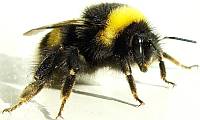
* body very fuzzy
* body black and yellow
* legs black
* body broad, chunky
* face black
* abdomen blunt at both front and rear ends
* wings shorter than body
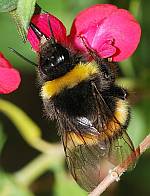
Bumble Bee on flower.