
5 Common Stingers | Which Stinger? | What Are Wasps and Bees? | Lives of Wasps and
Bees | Avoiding Stings
Which Hurts Most? | Allergy to Stings | First Aid | Control
| Links | Site Map
Text Copyright © 2009 Innogenesis Inc., All Rights Reserved










Ads by Google

The common stinging wasps and bees are all social insects. They typically live in small to very large colonies with a single reproductive female, the queen. The majority of members of the colony are sterile females, termed workers. A smaller number are males.
The sting of these insects has become the primary means used to defend their colonies from their enemies, including other insects and a variety of reptiles, birds and mammals. In the larger colonies, certain workers function primarily as guards, with defence of the colony as their major role.
In Bumble Bee, Yellowjacket, Bald-faced Hornet and Paper Wasp colonies, only the queen overwinters. In Spring the queen emerges from hibernation and begins gathering food and building a new colony. After she has laid eggs and raised her first crop of workers, the workers take on the food-gathering and nest-building roles and the queen spends most of her time laying eggs.
Only honey bees have evolved a method of overwintering, involving stored energy reserves of honey, that allows most of the workers to survive with the queen. Their colonies have a substantial head start in spring and can reach large population sizes of 50,000 or more individuals.
Bumble bees develop small, poorly organized colonies in underground burrows or in clumps of dead grass or vegetation. The wasps and Bald-faced Hornet construct hexagonal cells for rearing their young made of paper, organized in horizontal sheets or combs. Yellowjacket Wasps and Bald-faced Hornets surround their nests with a multi-layered paper sheath, while the Paper Wasps leave the cells exposed. Honey bees build vertical combs of hexagonal cells made of wax, usually in hollow trees or other protected locations.
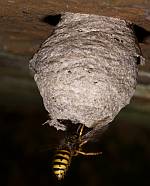
Yellowjacket Wasp queen working on very small nest in Spring.
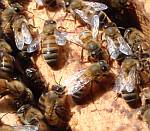
Honey Bees in hive.