
5 Common Stingers | Which Stinger? | What Are Wasps and Bees? | Lives of Wasps and
Bees | Avoiding Stings
Which Hurts Most? | Allergy to Stings | First Aid | Control
| Links | Site Map
Text Copyright © 2009 Innogenesis Inc., All Rights Reserved










Ads by Google

There are four main stages in the life history - egg, larva, pupa and adult. The less specialized Hymenoptera are mostly herbivorous, while the more specialized members, including the wasps and bees, include many species that are parasites or predators. In fact parasitic Hymenoptera are among the most beneficial insects as they control the population of many pest insect species.
There are many species of both wasps and bees, with a wide array of different appearances and lifestyles. These most specialized of the Hymenoptera also have evolved a wide range of kinds of social organization. This means that they live in colonies of a few or many related individuals and often display some degree of division of duties, with different individuals playing different roles within the colony.
The social lifestyle has allowed some wasps and bees to develop large populations and dominate the ecology of the communities in which they exist.
The ovipositor is a structure found in many insects that is used to deposit the eggs. In wasps and bees the ovipositor is frequently stiff and sharp and can be used to sting in defense. The development of venom glands means that the sting can be accompanied by the injection of a poison that increases the pain of the sting.
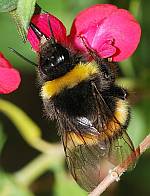
All wasps and bees are members of the insect order Hymenoptera.
All Hymenoptera have two pairs of wings that are usually transparent and display a characteristic pattern of branching veins. Front and hind wings are linked by a row of tiny hooks. This wing structure distinguishes them from other major orders of insects such as the butterflies and moths, the beetles, and the flies.
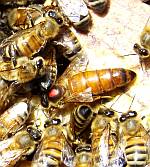
Honey Bee queen (in center, with red dot) surrounded by workers.