
5 Common Stingers | Which Stinger? | What Are Wasps and Bees? | Lives of Wasps and
Bees | Avoiding Stings
Which Hurts Most? | Allergy to Stings | First Aid | Control
| Links | Site Map
Text Copyright © 2009 Innogenesis Inc., All Rights Reserved










Ads by Google

The five most common stinging insects are all social members of the insect Order Hymenoptera, which means that effective control normally means elimination of the colony. Various traps and other devices are of little value in reducing the numbers of stinging insects in the area.
For all wasps and for Bumble Bees, the easiest way to remove a nest is to wait until early winter when several heavy frosts will have killed off all members of the colony except for the hibernating queen.
The best advice for colony removal in summer is to gain the assistance of a beekeeper or qualified insect control specialist. These individuals will have the kind of protective clothing that makes it possible to remove the nest without being stung.
If you must remove the nest yourself, do it at night when all of the workers and guards have returned to the nest. Introduce as much of the appropriate insecticide as possible into the nest in order to kill all of the workers and guards immediately.
Only remove and destroy the nest after all of its inhabitants have been eliminated.
When the nest is in an underground burrow or an enclosed space such as inside the wall of a building, removal will be especially difficult and hazardous. Again this is a job best left to the professional, for all of the insects must be eliminated before excavation or demolition to get at the nest can be attempted.
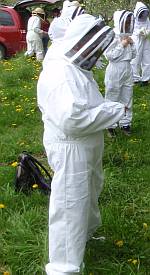
Left: Beekeepers in protective clothing.