
5 Common Stingers | Which Stinger? | What Are Wasps and Bees? | Lives of Wasps and
Bees | Avoiding Stings
Which Hurts Most? | Allergy to Stings | First Aid | Control
| Links | Site Map
Text Copyright © 2009 Innogenesis Inc., All Rights Reserved










Ads by Google

All insect stings are painful in order to serve as an effective self-defense mechanism. Depending on the type and quantity of venom injected there is considerable variation in the intensity of the pain following a sting. Entomologist Justin O. Smith has studied the relative pain caused by the stings of different wasps and bees. The list below is modified from Schmidt’s sting pain index and the sting pain scale of Christopher Starr.
Pain Level of Common Wasp and Bee Stings
(on a scale from 1 to 10)
Bald-faced Hornet - 4
Yellowjacket Wasp - 5
Honey Bee - 6
Bumble Bee - 6
Paper Wasp - 7
All of these common stingers, except for the Honey Bee, have a smooth-shafted stinger and can sting repeatedly.
Honey Bees have a barbed stinger that becomes firmly embedded in the skin of mammals. As a result, when the Honey Bee is removed from the site of the sting, its stinger pulls away from the bee’s abdomen dragging the poison gland out with it. The bee dies from this traumatic rupturing of its abdomen, but muscles in the poison gland continue to contract, pumping additional venom into the wound.
Although all of the common stingers will sting to defend the colony, some are more aggressive than others when away from their nests. The most likely to sting when away from the colony are the Yellowjacket Wasp and Bald-faced Hornet, and the least likely are the Bumble Bee and Honey Bee.
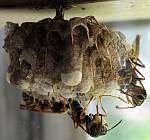
Paper Wasps on nest.