
5 Common Stingers | Which Stinger? | What Are Wasps and Bees? | Lives of Wasps and
Bees | Avoiding Stings
Which Hurts Most? | Allergy to Stings | First Aid | Control
| Links | Site Map
Text Copyright © 2009 Innogenesis Inc., All Rights Reserved










Ads by Google

* body smooth
* body black, yellow & brown
* legs orangey brown
* body long and tapering, wasp-waisted
* face black & brown
* abdomen tapering at both front and rear ends
* wings longer than body
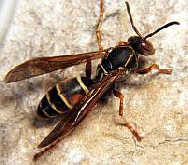
The Paper Wasp is a type of wasp that builds simple paper nests in protected locations above ground.
Behavior:
Paper wasps are carnivorous predators that attack flies and caterpillars, bringing them back to the nest to feed the larvae. They are not aggressive away from the nest and seldom bother humans.
Life Cycle:
The queen is the only member of the colony to overwinter. She emerges from hibernation in Spring and begins to hunt for food and build a nest. As she rears more and more workers, eventually they take on the task of foraging for food, expanding the nest and rearing the young. All workers die with the first early frosts and only the queen seeks a place to hibernate for the winter.
Nest Type:
Like other wasps, the Paper Wasp nest is built of a papery material fashioned into hexagonal cells that are joined in a horizontal comb. These wasps are distinctive in that there is usually only a single comb and they do not enclose the comb with a protective paper sheath. As a result, nests must be built in protected locations. Colonies are usually small with no more than a few dozen individuals.
Control:
The insect hunting activities of paper wasps are beneficial. But since they frequently build nests under the eaves and in other protected locations around human dwellings, it may become necessary to remove them. Paper Wasps will sting to defend their nest, but since their numbers are small, removal is easier than with other colonial wasps. The task should only be attempted at night and the nests are easily destroyed after the adult wasps are first dispatched with an effective contact insecticide.
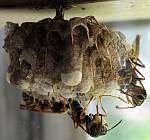
Paper Wasps on nest.
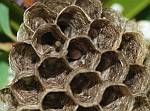
Cells in Paper Wasp nest.